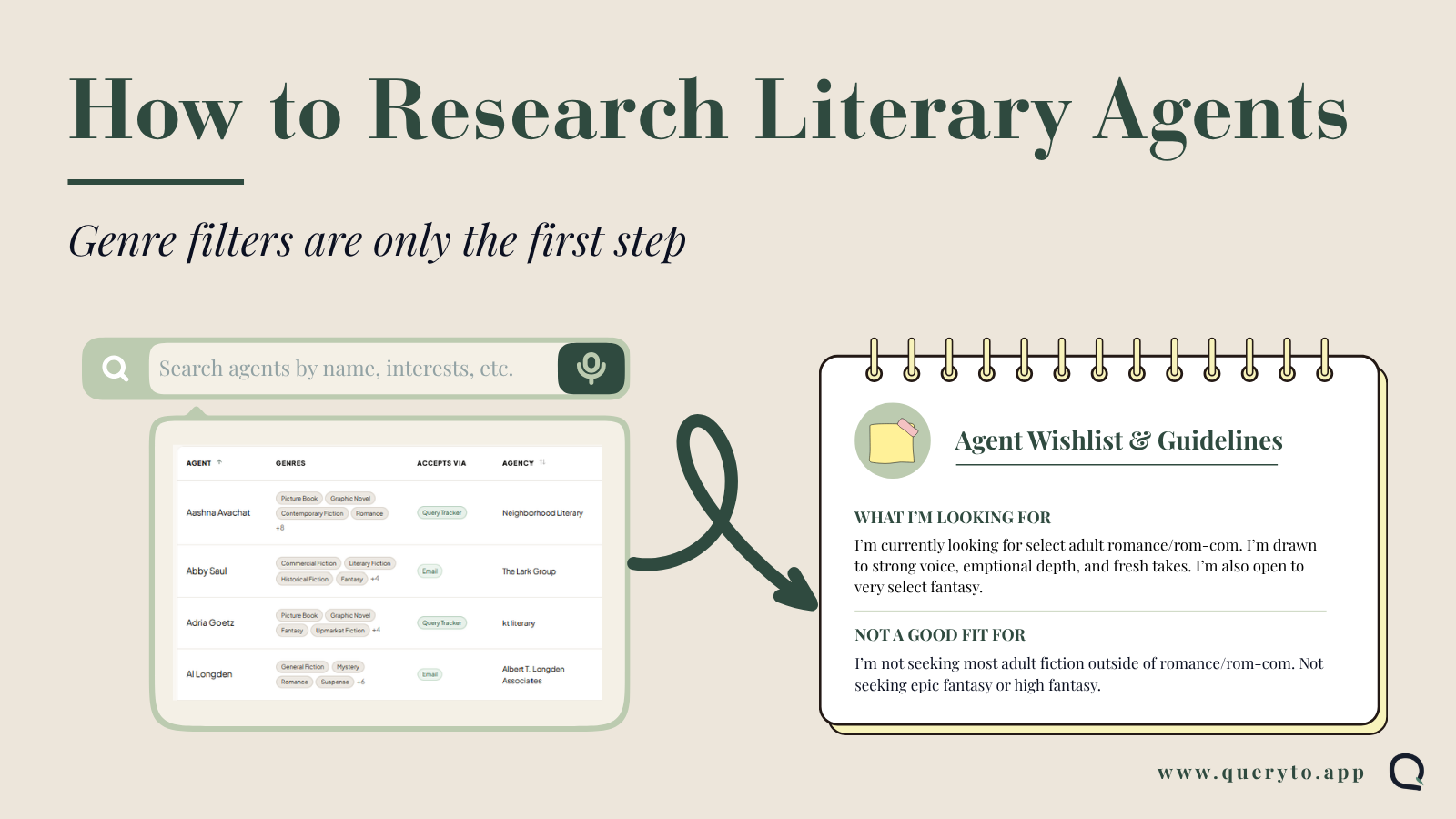
One of the easiest mistakes to make when researching literary agents is treating a search result like a wish-list.
Let's say for example, you're searching for an agent that represents Adult fiction. Just because an agent appears on that list doesn't necessarily mean that they want all Adult fiction.
Literary agent databases are designed to help you narrow a very large pool of agents into a smaller group worth researching. They are not a substitute for reading an agent’s full wishlist, MSWL, submission guidelines, agency profile, interviews, or other stated preferences.
An agent can represent Adult fiction without wanting most Adult fiction.
They can represent fantasy while being open only to a narrow type of fantasy.
They can want romance in YA but only very selectively in Adult.
They can be open to dystopian fiction while having no interest in aliens, space, time travel, or portals.
All of those things can be true at the same time.
And that is exactly why genre and age-category filters should be the beginning of your literary agent research, not the end of it.

What Literary Agent Genre Filters Actually Mean
When you use a literary agent database and filter by age category, genre, or subgenre, you are usually asking a broad question:
Does this agent represent or seek work somewhere within this category?
That is very different from asking: Does this agent want my specific manuscript?
The first question can be answered reasonably well with structured data.
The second requires context.
That context may include:
- subgenre
- tone
- themes
- setting
- audience
- narrative style
- subject matter
- level of romance
- the role a particular element plays in the story
- whether an interest applies to YA, Adult, or both
- what the agent explicitly does not want
This is why two authors writing books that technically fall under the same genre can have completely different levels of fit with the same literary agent.
Why an Agent Can Appear in Your Search and Still Not Want Your Book
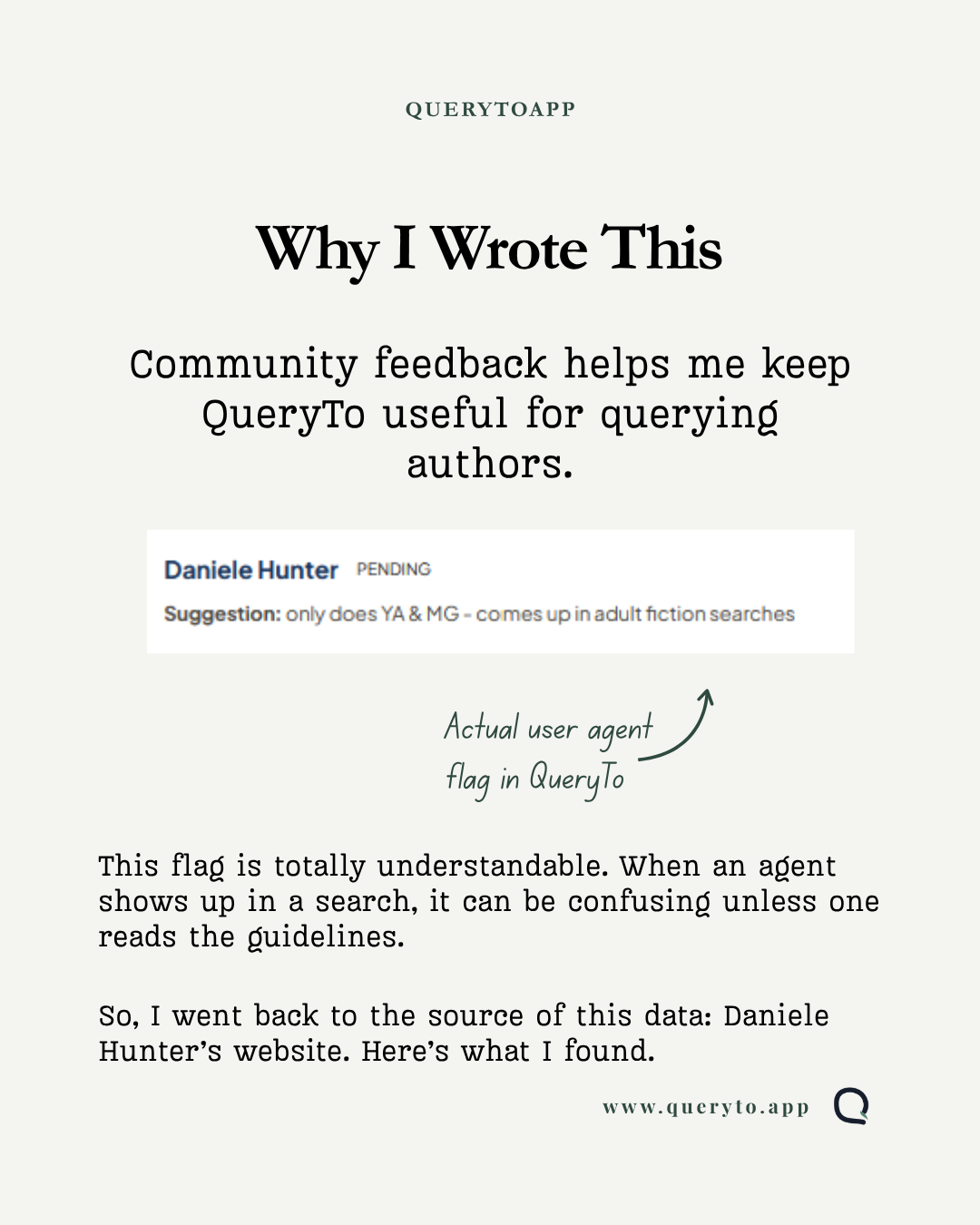
To make this real, let's use literary agent Daniele Hunter.
On QueryTo, Daniele appears under several age categories, including Adult.
At first glance, an author might see that and assume she is broadly open to Adult fiction.
But she isn't. However, Adult still belongs on her profile.
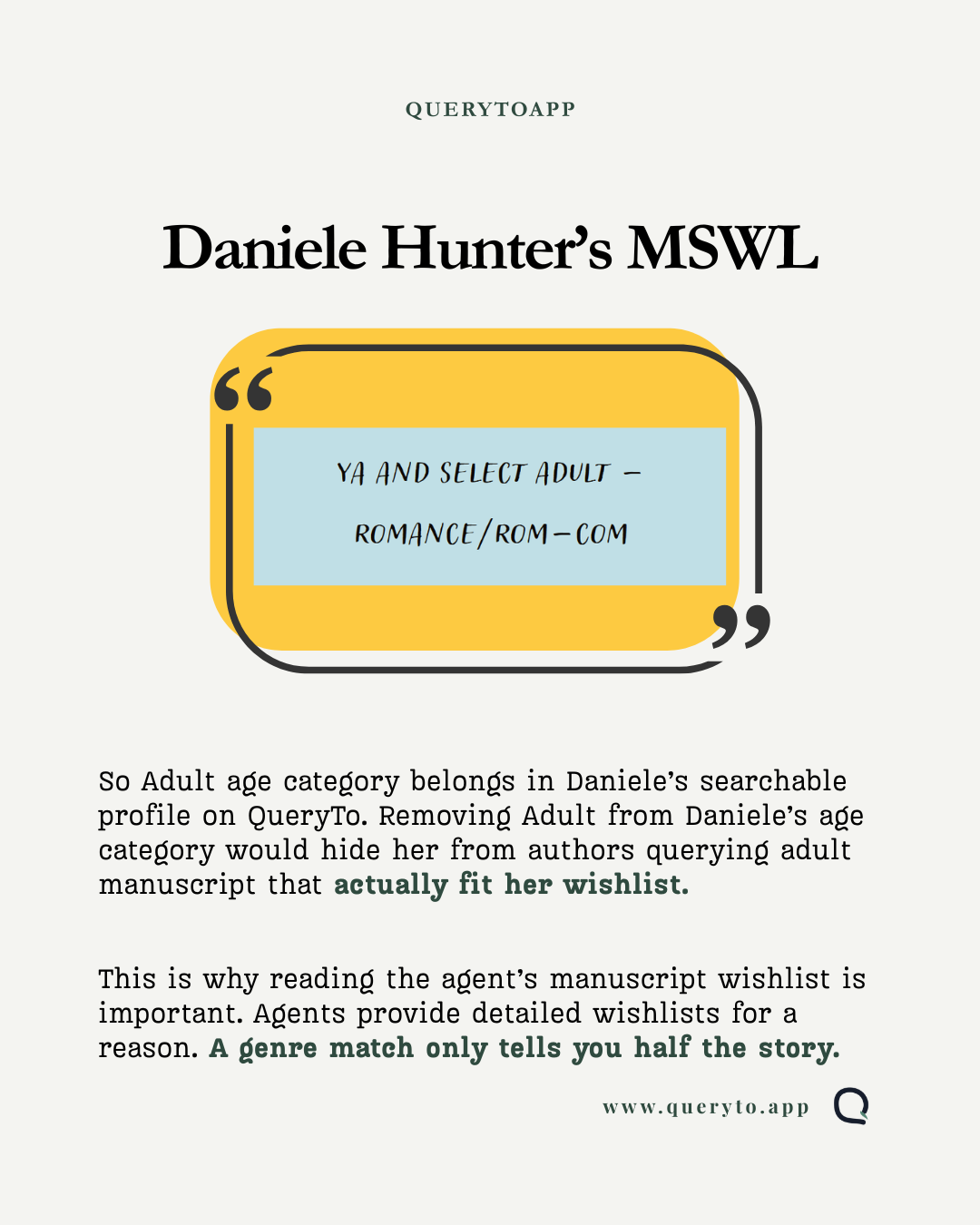
Daniele states on her own wishlist that she is open to select Adult romance and romantic comedy, in addition to YA. She is especially interested in Adult romance involving disability, queerness, or asexuality.
At the same time, she also makes clear that she is not looking for most other Adult fiction.
If Adult were removed from her profile entirely simply because the majority of her interests skew younger, an Adult author with exactly the kind of romance Daniele is seeking might never discover her.
That would make the database less accurate.
Literary Agent Genres Are Broad. Wishlists Are Specific.
Structured data makes literary agent search possible. A directory needs fields such as:
- age category
- genre
- subgenre
- specific interests
- hard nos
- submission status
Without those categories, authors would have no practical way to narrow thousands of agents into a usable shortlist.
But it would be amiss to focus on just the broad categories and ignore the wish-list.
For example, Daniele is open to near-future dystopian fiction. In QueryTo, dystopian rolls up under the broader Science Fiction category, so Science Fiction appears on her profile.
That does not mean she is broadly seeking science fiction. Her own wishlist makes clear that she is not interested in many common science-fiction elements, including aliens, space, time travel, and portals.
So if an author searches for Science Fiction and sees her profile, the correct conclusion is not:
She wants science fiction.
It is that She may be relevant because she seeks a particular kind of science fiction. I need to read further.
Broad genre searches help you find an agent's profile. But it is the agent's detailed wishlist that tells you if your book is a fit.
The Same Thing Happens Within Fantasy, Romance, Mystery, and Horror
This issue is not unique to age categories. It happens inside genres too.
Daniele, for example, is interested in contemporary fantasy, especially lyrical, character-focused stories and ghost stories with strong emotional plots.
She is also selectively open to higher fantasy under certain conditions.
That does not mean she is interested in every kind of fantasy.
Likewise, an agent can represent romance but prefer only certain kinds of romantic stories, or take mystery while having strong preferences around tone, structure, police involvement, or subject matter.
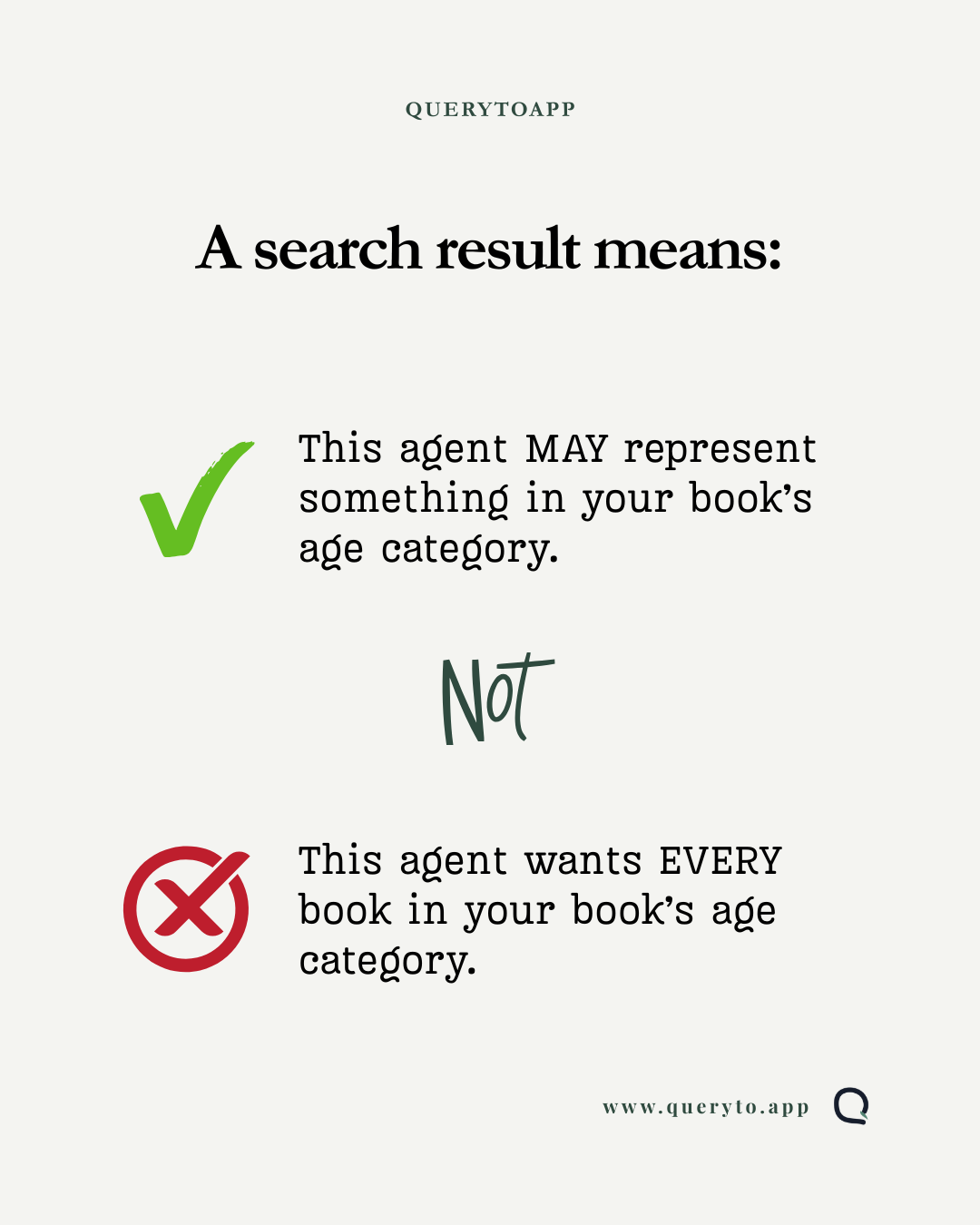
Seeing an agent under a genre filter should therefore never be interpreted as: This agent takes my genre, so I should query them.
A better interpretation is: This agent represents or seeks some work within my genre, so they are worth researching.
How to Read a Literary Agent Wishlist
A literary agent wishlist, sometimes called an MSWL, is where much of the nuance lives.
This is where agents often explain what they are especially interested in, what they are currently tired of seeing, what themes they love, and what kinds of stories are likely to catch their attention.
Daniele’s wishlist is a good example because it includes interests that would be impossible to communicate through a few genre checkboxes alone.
Among other things, she has expressed interest in:
- grief as a meaningful focus rather than a convenient plot device
- characters who have lost a parent or friend
- chronic illness and disability representation
- asexual characters
- fat characters who are not interested in weight loss
- pets, especially cats and black cats
- beach settings
- non-fairytale retellings
- singers, music, and musical theatre
- childfree characters
- knitting
- gymnastics and swimming
- speech disorders, especially apraxia
- diverse holiday stories
That level of specificity is valuable because deciding whether to query an agent shouldn't boil down to simply this agent takes my genre, but rather this agent may actually be interested in the kind of story I wrote.
This is the proper way to do agent research.
Literary Agent Wishlist vs. Submission Guidelines
There is also a difference between an agent's wishlist and an agent's submission guideline.
A wishlist or MSWL tells you what kinds of books the agent is interested in.
Submission guidelines tell you how and what to submit.
For example, an agent’s wishlist might tell you that they are interested in queer Adult rom-coms featuring disabled protagonists.
Their submission guidelines might tell you to send:
- a query letter
- the first ten pages
- a synopsis
- a particular subject line
- submissions through a specific channel rather than through email
When researching a literary agent, you should ideally check:
- What do they represent?
- What are they actively seeking?
- What are they especially interested in right now?
- What have they explicitly said they do not want?
- How do they want you to submit?
Pay Attention to Qualifiers
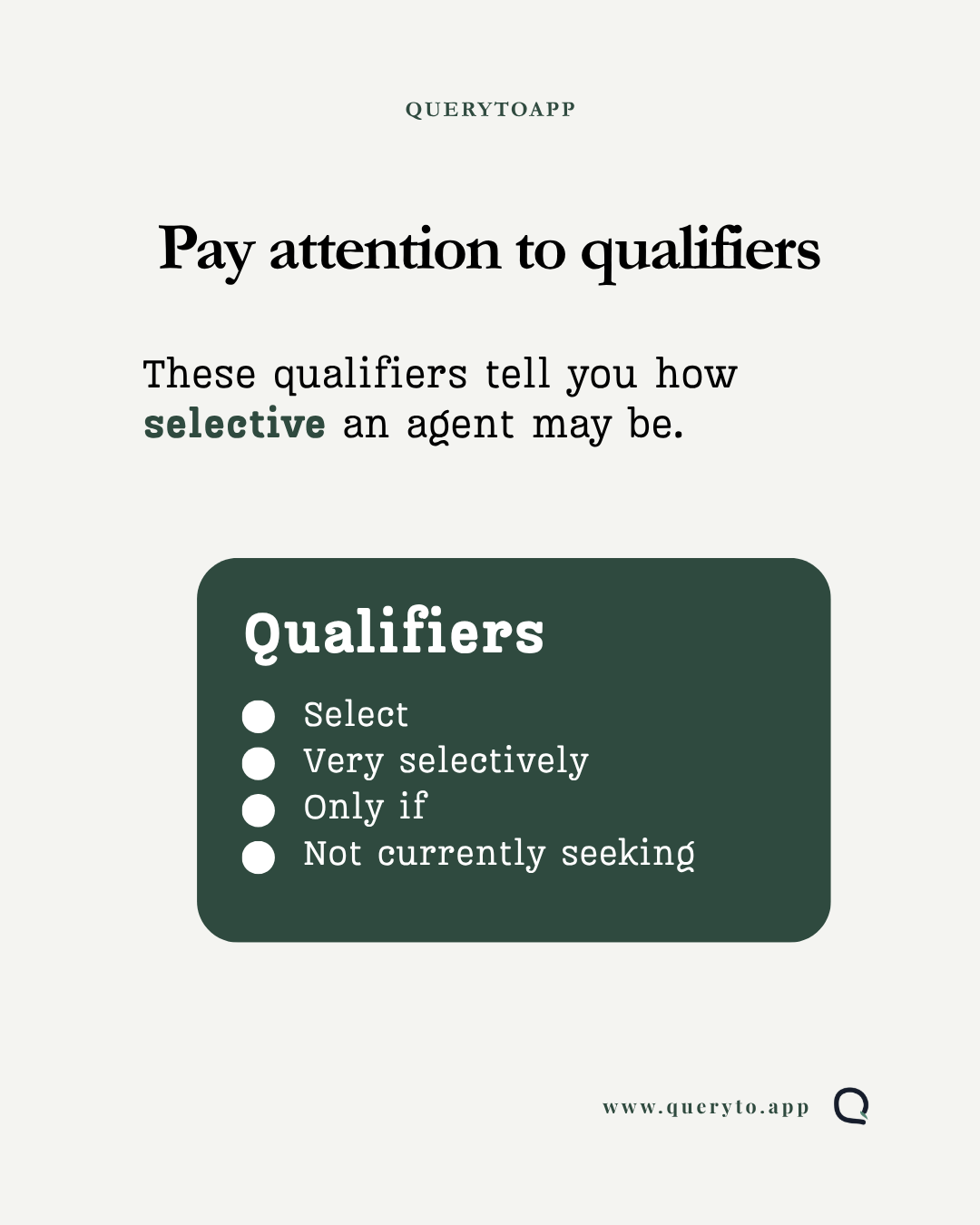
Another thing to pay attention to in an agent's MS wishlist are the qualifiers they use. These are words and phrases such as:
- select
- very selectively
- especially interested in
- not currently seeking
- only if
- open to some
- sparingly
If an agent says they take “select Adult fiction,” then you should pay careful attention to the select Adult fiction they are seeking.
If they say they are “very selectively” open to high fantasy, you need to understand what type of high fantasy they are seeking.
If they say they are open to romance only when it contains particular themes, you want to know what those themes are and if your book has those themes.
“Represents” and “Seeking” Are Not the Same Thing
An agent may represent a category without currently being eager to acquire more of it.
They may have clients writing fantasy, wish to diverse their client genre pool, and thus be more interested in contemporary fiction.
They may technically remain open to a genre while saying they are being especially selective because the market has become difficult.
They may represent Adult fiction while currently seeking only one narrow type of Adult project.
So when researching an agent, do not stop at: What does this agent represent?
You need to also ask: What are they seeking now?
An agent’s client list tells you who the agent has represented in the past and present. This can help guide in what types of MS the agent represents or seeks. But it is still the wishlist that ideally tells you what they are seeking. Both the client list and wishlist are useful, but they provide different (and sometimes, similar) data points.
Search Results Tell You Who to Research, Not Who to Query.
When researching literary agents, begin with a very large pool of possible agents. Next, you want to filter your agent list by your project’s basic characteristics such as genre. Filtering narrows down the pool of agents and gives you your first real list. This is the first step in your agent research. You should not stop here.
Next, you want to read the agent’s full profile, read their current wishlist or MSWL, read their submission guidelines.
Pay careful attention to whether their interests differ by age category. Also pay attention to what they say they are not a good fit for. Pay attention to qualifiers.
After all that is when you then decide whether you should query them.
Why QueryTo Does Not Simply Remove Broad Categories
It might seem easier to solve this problem by removing an age category or genre whenever an agent is highly selective. But as noted above, this will make the data inaccurate.
If an agent takes select Adult romance and Adult is removed because most of their interests are YA or Middle Grade, Adult authors who fit that narrow interest may never discover them.
QueryTo's approach is to preserve the broad searchable category while also providing enough detail for authors to understand the limits of that category.
Agent profiles also have the source links. The links are there so you can also go directly to the source should you wish.
How to Build a Better Literary Agent Shortlist
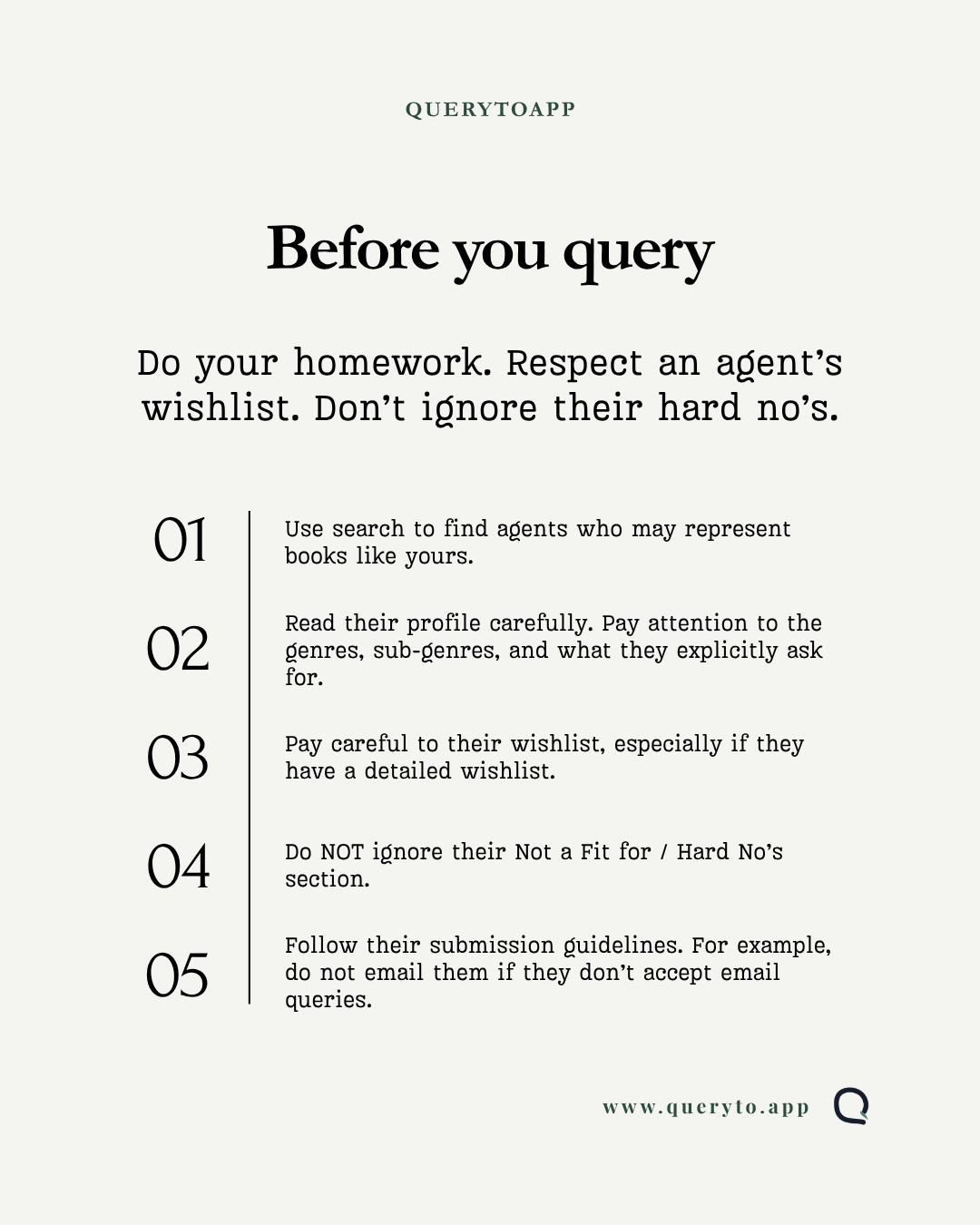
The goal of literary agent research is not to produce a list of agents who are guaranteed to want your manuscript.
No database can do that.Publishing is too subjective. I have learned that in this industry, there are always exceptions. Always. Absolutes are simply not a thing.
Your goal, when determining who to query, should be to go from thousands of possible agents to a thoughtful shortlist of people who are genuinely worth researching and potentially querying.
So before adding an agent to your query list, ask:
- Does the agent represent my age category?
- Do they represent my genre or subgenre?
- Does that interest apply specifically to my age category?
- Is the agent currently seeking this kind of project?
- Are there qualifiers that narrow their interest?
- Does my manuscript align with any of their stated wishlist interests?
- Does it conflict with anything they explicitly do not want?
- Have I read their current submission guidelines?
And yes, this process is not something you can get done in 5 minutes. It takes time. But the query list you end up with will be better off for it if you take the time. And you only get one shot with an agent for your MS. You want to make it count.
I built QueryTo to help cut down the time. So yes, QueryTo makes literary agent research faster. It however does NOT eliminate the in-depth research you still need to do to make sure an agent is the right fit for your book.
And you know what they say in the trenches? No agent is better than a bad agent. Do your homework. Don't cut corners.
 Querying, Publishing Industry, Success Stories, Community, Agent InsightsThe QueryTo Society Papers, Volume 2412 min read
 Querying, CommunityWriters Wanted! Here's What's Happening in the QueryTo Community2 min read
 Querying, Agent Insights5 Literary Agents Seeking Dark Academia Manuscripts3 min read
 Querying, Platform UpdatesHow to Import Your Existing Queries into QueryTo5 min read
Query with more confidence.
Use QueryTo to research literary agents, organize your query materials, and track submissions in one place.